What Is an AI Overview Citation?
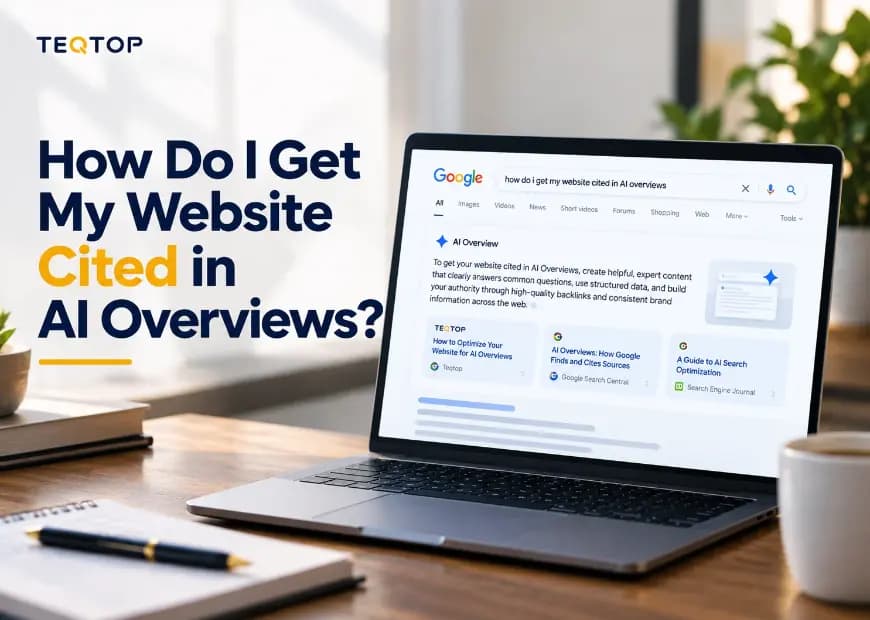
An AI Overview citation is a link to your page shown inside the summary that Google AI Overviews generates for a search. Google builds the answer from several sources and attaches links to the pages that supported it. Being cited means a passage from your page helped form that answer.
This is not the same as ranking. A page can rank third and never be linked in the summary, and a page ranking far down the results can be linked. It is also not the same as a brand mention, where the summary names your company in text without linking to you. Both matter for AI Overviews visibility, but they are earned in different ways, and mixing them up makes results hard to read later.
One more point before going further: a citation does not always produce a click. Some readers get what they need from the summary and leave. The value is partly traffic and partly that your name appears as a source at the moment someone is making a decision.
Check Eligibility Before Changing Any Content
Most guides jump straight to writing advice, but the first question is whether your page can be used at all. Google’s documentation states that a page must be indexed and eligible to appear in Search with a snippet. It also states that there are no additional technical requirements beyond that. So if a page fails here, no amount of good writing will get it cited.
These are the places where pages quietly fail:
- Snippet controls. A nosnippet tag, a restrictive max-snippet value, or a data-nosnippet attribute wrapped around your best paragraph tells Google not to show that text. Those controls are exactly how Google says to limit use of your content in AI features, so a plugin or theme that adds them by default can remove you without anyone noticing.
- Blocked or noindexed pages. A leftover noindex from a staging site, or a robots.txt rule that blocks a folder of service pages, keeps them out entirely.
- Text that appears only after a script runs. If the answer is injected by JavaScript, or sits inside an image or a PDF, Google may not read it the way a visitor does. Open the URL Inspection tool in Search Console and compare the rendered HTML with what you see on screen.
- Duplicate versions. If the same article exists on your site and on a syndication partner, Google may choose the other copy as the source. A clear canonical tag and original wording on your own page reduce that risk.
- Pages with no internal links. Google recommends making content easy to find through links within your site. A well-written page that nothing links to is harder to discover and easier to ignore. Basic technical SEO checks cover most of this list.
A common mix-up is worth clearing up here. Blocking Google-Extended in robots.txt does not take you out of AI Overviews, because that control relates to Google’s AI model products and not to Search. Snippet controls are what govern Search. Google has also described a Search generative AI setting inside Search Console that lets owners include or exclude their content, though it was rolling out to a subset of site owners at the time of writing, so check whether it appears in your account.
How Google Chooses Which Pages to Cite
Google AI Overviews use a technique called query fan-out. When someone searches, Google does not run only that one search. It also issues related searches on subtopics and combines what it finds. The pages cited are the ones that best answer those smaller questions, which is why they are not always the pages ranking highest for the original query.
Take a search such as “how much does a Shopify store cost to build.” Behind it, Google may be looking for answers to several narrower questions:
- What does a Shopify plan cost per month?
- How much do paid themes cost compared with a custom theme?
- What does a freelance developer or agency charge for a store build?
- Which apps carry monthly fees that surprise store owners?
- How long does a store take to launch?
- When is WooCommerce a cheaper option?
A single page that mentions cost in one paragraph covers none of those well. A page with a short section for each does, and any one of those sections can be picked on its own.
The evidence for this is in the citation data. Ahrefs studied 863,000 keyword results and about 4 million cited URLs. Roughly 38% of the cited pages ranked in the top 10 for the query, about 31% ranked between 11 and 100, and another 31% were outside the top 100 altogether. An earlier Ahrefs analysis had found around three quarters of citations coming from page one, so the pattern has moved toward passage-level matching. Ranking helps, but it is no longer the gate.
Write Sections That Can Stand Alone
Because Google can lift a single passage, each section of a page needs to make sense when read without the rest. In practice that means four habits.
Put the answer first. Under each heading, state the answer in the opening sentence or two, then add the detail. A reader gets what they came for, and the passage is ready to be quoted.
Name the subject. Sentences that begin with “this,” “it,” or “both” lose their meaning once separated from the paragraph before them. Use the actual noun.
Match headings to real questions. A heading like “Our Approach” gives Google nothing to match. “How long does a Shopify store take to launch?” gives it an obvious fit.
Keep one topic per section. A section that answers three questions answers none of them cleanly.
Ovelovia’s own DC AI SEO guide is cited in AI results for that keyword, and it shows these habits at a small scale. It runs about four minutes. It defines the topic under a heading that is the question itself, it names Washington, Arlington, Bethesda and Alexandria instead of saying “the area,” it keeps five steps in a short list, and it ends with FAQs whose answers each name their own subject. Nothing about it is long or elaborate.

Even so, a careful edit shows how the idea works. The page’s opening definition reads: “DC AI SEO is the work of making sure your business is one of the names in both places.” The phrase “both places” points back to the sentence before it, so if Google lifted this line alone it would mean little. A version that stands on its own would read: “DC AI SEO is the work of helping a Washington business appear in Google results and in the answers that ChatGPT, Gemini and Perplexity give.” The meaning is the same, and the second version can be quoted as it is.
Support Claims With Evidence and Dates
Google tries to avoid repeating claims it cannot verify, so a statement with a source attached is easier to use than a bare assertion. Name who found something and when: “an Ahrefs study of 863,000 keyword results” is stronger than “studies show.” If you have your own numbers, such as load times before and after a rebuild or the results of an audit, publish them, because nobody else can supply those figures.
Freshness works the same way. Changing the date at the top of a page does nothing useful. Replace figures that have aged, remove advice that no longer applies, and add what has changed since the page was written. Pages that compare tools, list costs or describe a process need this most, because the facts in them move.
What Schema Can and Cannot Do
Some guides call structured data the strongest factor for appearing in AI Overviews. Google’s own guidance does not say that. It says no special markup is needed for generative AI features, and it asks only that any structured data you use matches the visible text on the page.
That does not make schema pointless. Article, Organization, FAQ and Product markup remain useful for rich results and for helping systems understand a page. The mistake is selling it as a shortcut to an AI Overview citation, or adding markup for details that appear nowhere on the page, which can lead to a manual action. Treat schema as tidy housekeeping and put the real effort into the content.
Build a Presence Outside Your Own Site
Google AI Overviews draw on far more than company websites. Forums, video, encyclopedias, news and review sources all appear among the links, and a business with consistent details in many places is easier for Google to trust.
- Keep your company name, address, phone number and service area identical on your site, Google Business Profile and any directory that lists you.
- Answer real questions on Reddit and Quora where it is useful and permitted, without dropping links to your own pages.
- Publish videos with accurate titles and transcripts on YouTube, since Google reads them.
- Earn mentions in industry publications, partner pages and review platforms where your buyers look.
Mentions without links still help. When your brand repeatedly appears next to the topics you want to be known for, the association builds over time.
Which Queries Are Worth Going After
Not every search is a fair target, and knowing the difference saves months. Medical, legal and financial questions tend to cite government sites, hospitals and established publishers, so a small business has a difficult climb there. Very broad head terms often cite large reference sites. The realistic opportunities are narrow, specific, often practical questions, which is where fan-out creates room for smaller pages.
Consider a typical pattern. An agency’s service page ranks third for “WordPress development for nonprofits.” The AI Overview for that search links to a Reddit thread and two comparison articles instead, because the service page describes the agency in general terms and never says what a nonprofit site build includes or costs. Meanwhile a blog post that ranks around thirty-fifth for “can I switch my WordPress theme without losing content” gets cited, because one paragraph in it answers that exact question in two sentences. The first page ranks but cannot be quoted, and the second can be quoted but does not rank. Closing that gap for the first page usually means adding short, specific answer blocks to it, not rewriting the whole page.
How to Track AI Overview Citations
No single tool gives a complete picture, so a combination works best.
Google Search Console. Traffic from AI features is counted within your overall Search performance data. Watch impressions for question-style queries on the pages you have edited. Rising impressions with flat clicks is a common sign that your content is being shown but not always clicked.
Semrush and Ahrefs. Both can show whether a keyword triggers an AI Overview and which domains are cited, and Ahrefs offers brand-level tracking across AI platforms. These are useful for comparing yourself with competitors across a long keyword list.
Google Analytics. Look at referral traffic from sources such as chatgpt.com and perplexity.ai. This does not measure Google AI Overviews directly, but it shows how other AI tools send visitors.
Manual checks. These matter more than people expect, because AI Overviews change with wording, location and time. Build a short sheet with twenty to thirty target queries and check them in a private window at the same location each week. Record the date, whether an AI Overview appeared, whether you were cited, which of your URLs was used, and who else was cited. Three or four weeks of entries will tell you more than a single check, since one result can be a random swing.
Mistakes That Keep Pages Out
- Stating the answer in the fourth paragraph instead of the first
- Vague headings that match nothing anyone searches
- Pages that contradict each other on prices, services or locations
- Two pages on the same topic competing for one question
- Dates refreshed without any real update
- Key text sitting inside images, PDFs or script-loaded elements
- Snippet restrictions added by a plugin and never reviewed
- Schema that describes content visitors cannot see
- Treating a guarantee from an agency as a plan, when no one controls what Google cites
Where Ovelovia Fits In
Getting cited comes down to three things working together: pages that Google can read and show, sections that answer specific questions, and enough credible mentions elsewhere to back them up. Ovelovia builds and fixes the site itself, writes the content, and tracks the results, so these pieces do not sit with separate teams. If you want to know which of your pages are eligible today and which questions you could realistically win, our AI SEO services begin with an audit that answers exactly that.
Frequently Asked Questions
Do I need to rank in the top 10 to be cited in Google AI Overviews?
No. Ahrefs found that around 31% of cited URLs ranked outside the top 100 for the query, though ranking well still helps.
Is there special markup for AI Overviews?
No. Google states that structured data is not required and that no special AI markup exists. Use schema only where it matches visible content.
How long does it take to earn an AI Overview citation?
It depends on how often Google recrawls your pages and how competitive the query is. Technical fixes can show effects within weeks, while authority built through outside mentions takes longer.
Can I stop Google from using my content in AI Overviews?
Yes. Snippet controls such as nosnippet, data-nosnippet and max-snippet, along with noindex, limit how your content appears.
Why does my competitor get cited when my page ranks higher?
Google picks passages, not pages. Their page may answer one narrow question more clearly than yours does.
Take Your Brand to the Next Level
From SEO and AI to web development and digital marketing, Ovelovia helps businesses build visibility, authority, and long-term growth.
Get Expert Guidance →