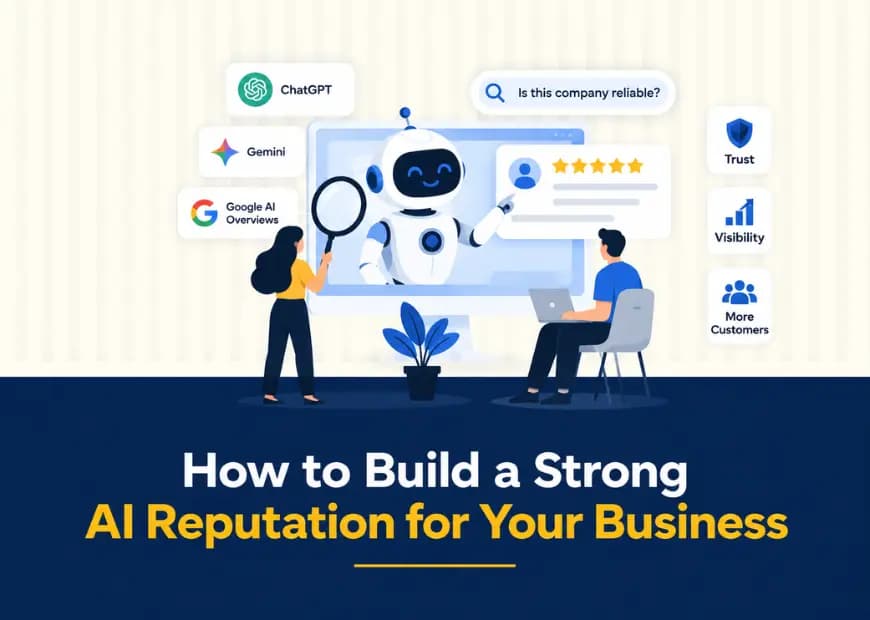
Why Your Brand's AI Reputation Actually Matters
Think about how you'd answer a friend who asked, "Do you know a good accountant?" You'd probably mention someone you've worked with, maybe add a detail or two about what made them good. AI tools are trying to do something similar, except they're pulling from thousands of data points instead of personal experience.
That means your brand's AI reputation isn't built on one thing. It's built on patterns: what your reviews say, how consistent your business details are across the web, whether other credible sources mention you, and whether your own content actually explains what you do and who you help.
When those signals line up, AI tools have an easier time describing your business accurately and recommending it. When they don't, you either get left out of the conversation or, worse, described inaccurately to someone who was ready to buy.
Start by Checking What AI Already Says About You
Before you fix anything, find out where you actually stand. Open up a few AI tools and ask them questions the way a real customer would:
- "What does [your business] do?"
- "Is [your business] a good choice for [service]?"
- "Who are the top [your industry] companies in [your city]?"
- "What do people say about [your business]?"
Pay attention to what comes back. Is the information correct? Does it mention your actual services, or something outdated? Does your business show up at all when it's relevant? If competitors get mentioned and you don't, that's a gap worth understanding.
This step alone usually tells you a lot. Some businesses find their AI Brand Rankings are solid because they've kept their online presence tidy for years without ever thinking about AI specifically. Others discover their listings are years out of date, or that AI has no real sense of what makes them different from the business down the street.
Get Your Business Information Consistent Everywhere
This one sounds boring, but it's foundational. If your address, phone number, hours, or service list are different on your website than they are on Google Business Profile, Yelp, or your industry directory listings, AI has no reliable way to know which version is correct. Inconsistency doesn't just confuse customers, it confuses the systems trying to describe you.
Go through the basics on every platform where your business appears:
- Address and phone number
- Hours of operation
- Services offered
- Service areas
- Website link
It's tedious work, but it's also one of the more controllable pieces of AI-powered reputation management. You're not trying to influence an algorithm you can't see. You're just making sure the facts about your business are the same everywhere someone, or something, might look.
Reviews Still Carry Enormous Weight in AI Reputation Management
If there's one thing that hasn't changed, it's this: reviews matter. AI tools lean heavily on them because reviews are one of the few places where real customers describe, in their own words, what it's like to work with you.
A short "great service, would recommend" review doesn't give an AI much to work with. A review that mentions the specific service, what problem it solved, and maybe even who on your team handled it gives AI a lot more to draw from. That's the kind of detail that shows up in AI-generated summaries.
If you're not actively asking happy customers for reviews, or if your review volume has stalled, that's worth fixing first. AI-powered review management tools can help you stay on top of this without it becoming a full-time job, but even a simple habit of asking every satisfied customer for feedback will move the needle over time.
And don't skip responding to reviews, including the negative ones. A calm, specific response to a bad review does two things: it shows real customers you take feedback seriously, and it gives AI tools more context about how your business handles problems. Silence on a bad review reads as a red flag to both.
Let Other Sources Talk About You
AI tools don't just trust what you say about yourself. They give more weight to businesses that get mentioned by other credible sources, whether that's a local news article, an industry publication, a partner's website, or a directory in your field.
This doesn't mean chasing every possible mention. It means being intentional. Sponsor a local event and let the organizer link back to you. Offer a quote to a reporter covering your industry. Get listed properly in the directories that matter for your field. Each of these adds a small piece of outside validation that AI tools can factor in when deciding how much to trust what's being said about your brand.
Content That Actually Answers Questions
Your website is still one of the biggest sources AI pulls from directly, so it needs to do real work. Vague, generic pages don't give AI much to summarize. Specific, useful content does.
Think about the questions your customers actually ask before they buy. What's your process for a job like theirs? What does a brand's ai reputation typically cost? What makes your approach different from a competitor's? A page that answers those questions in plain language, using real examples from your business, gives AI tools something concrete to pull from when someone asks about your industry.
This is also where a lot of businesses get pulled into thinking they need to write more, when really they need to write more specifically. A detailed page about one service beats a vague page trying to cover five.
Keep Watching, Because This Isn't a One-Time Fix
Reputation shifts. A bad review comes in, a competitor gets more press, a listing goes stale, and suddenly the picture AI has of your business is a little off from reality. Checking in occasionally, maybe once a quarter, lets you catch problems while they're small.
Set a reminder to run those same AI search questions again. Look at your review trends. Scan for any new mentions, good or bad, showing up about your business. This kind of light, ongoing attention is really what separates businesses with a strong, durable AI reputation from ones that got lucky once and never checked again.
Bringing It All Together
None of this works in isolation. A business with great reviews but inconsistent listings still confuses AI tools. A business with consistent listings but no outside mentions still looks thin compared to competitors who've earned some third-party credibility. Building a strong profile using AI reputation management means working on all of it together: what customers say, what your listings show, what other sources confirm, and what your own content proves.
The businesses that get ahead of this now, while a lot of their competitors are still treating it as optional, are the ones that'll show up when it counts. Someone asking an AI tool for a recommendation in your industry is, in a lot of ways, no different than someone who used to ask a friend. You want to be the name that comes up.
What Not to Do
A few habits quietly undermine brand’s AI reputation work faster than they build it:
- Buying fake reviews
Review platforms and AI tools are both getting better at spotting unnatural patterns, like a sudden spike of generic five-star reviews in a tight window. This can do more damage than having no reviews at all.
- Keyword-stuffing your "About" page
Cramming in every service and city name doesn't help AI understand your business better. It usually reads as less trustworthy, to AI systems and real visitors alike.
- Assuming AI only reads Google
Many businesses focus all their review energy on Google Business Profile and ignore Yelp, Facebook, or industry-specific platforms. AI tools pull from a wider net than that.
Different AI Tools Don't Work the Same Way
Treating AI reputation management as one single target is a mistake, each tool pulls from different sources:
- Google AI Overviews
Leans heavily on Google Business Profile data and content already indexed through Google Search
- ChatGPT and general chatbots
Draw more on a mix of training data and live browsing, which can be slower to reflect a recent listing change or new review
- Gemini
Pulls from Google's ecosystem but doesn't always weight sources identically to AI Overviews
Fixing your presence for one tool doesn't automatically fix it for all of them. Test the same questions across a few different AI tools to get an accurate picture of where the gaps actually are.
Structured Data Makes This Easier for AI to Get Right
Structured data (schema markup) makes accurate information easier for AI to extract correctly:
- LocalBusiness schema
Gives AI systems a clean, structured version of your address, hours, and contact details instead of requiring them to interpret paragraph text
- FAQ schema
Does the same for common customer questions
- Review schema
Can help surface aggregate rating information directly
This doesn't replace the reputation work above, it just removes guesswork for the systems trying to summarize your business.
This Doesn't Require a Big Budget
Most of what improves brand’s AI reputation management is time, not money:
- Free to do yourself: fixing inconsistent listings, asking customers for detailed reviews, responding to feedback
- Worth paying for eventually: ongoing monitoring at scale, or managing reputation across dozens of locations
- Bottom line: a business spending a few hours a month on this will usually see more improvement than one that buys a tool and never checks on it
How to Tell If It's Working
Track progress with a few simple checks:
- Re-run your test prompts every few months and compare answers for accuracy and tone
- Watch review trends, volume, detail level, and response rate over time
- Check analytics for AI referral traffic, some platforms are starting to break this out as its own category
- Look for consistency, are your listings still matching across platforms, or has something drifted?
What to Do When AI Gets It Wrong
There's no direct way to edit what an AI tool says about your business. No dashboard, no correction form. Fix it by working backward through the likely source:
1. Identify the likely source
An outdated directory listing, an old news mention, a stale review, or thin content that left the AI guessing
2. Correct it at the source
Update the listing, request a correction from a publication if warranted, or add clearer content to your own site
3. Give it time
AI-generated answers tend to catch up once sources are consistent, though it can take a few weeks or longer
4. Re-audit if it persists
Ongoing inaccuracies usually mean multiple sources still disagree with each other
FAQ
What is AI reputation management?
It's the practice of managing the reviews, listings, mentions, and content that shape how AI tools like ChatGPT and Google AI Overviews describe and recommend your business.
How is this different from regular SEO?
Traditional SEO focuses on ranking in search results. AI reputation management focuses on how AI systems interpret and summarize information about your brand, which draws on a wider mix of signals, including reviews and third-party mentions.
How do I check my current AI reputation?
Ask AI tools direct questions about your business, similar to what a customer would ask, and see how accurately and favorably they respond.
Does review volume actually affect AI rankings?
Yes. More detailed, recent reviews give AI tools richer information to draw from, which can influence how confidently they recommend your business.
How often should I check on this?
Quarterly is a reasonable starting point for most small and mid-sized businesses, though industries with fast-moving reputations may want to check more often.
Take Your Brand to the Next Level
From SEO and AI to web development and digital marketing, Ovelovia helps businesses build visibility, authority, and long-term growth.
Get Expert Guidance →